

TL;DR This article reviews the most interesting domain name generators available online — including classic tools like NameMesh and Domainr, as well as AI-powered options like Namelix that have emerged since 2020. Whether you’re looking for a .com for your startup or a creative branded name, these tools can save hours of manual brainstorming. These tools help users brainstorm creative, memorable, and available domains, which is especially useful in the era of countless new extensions. From advanced platforms like NameMesh with SEO-focused suggestions, to simple multilingual tools like Naminum, or creative solutions like WORDOID, each has its strengths and limitations. The review also includes Impossibility!, which is more restrictive, and Domainr, which is great for discovering unique extensions and availability details. Together, these tools give entrepreneurs, marketers, and website owners practical support in finding the perfect domain name for their projects.
There are many domain name generators available on the web. Before launching one of them, it is worth focusing on the topic of selecting the name which our domain will use.
Domain names generators – introduction
Fortunately, the universe knows no vacuum – especially in the Internet industry. Therefore, the industry dynamically responds to the needs of its customers. It results in the huge number of the tools meant to facilitate, often offering their service in return for free access to the tool a weary Internet user in navigating in the virtual world.
In response to the unquestionable demand of users (including the constantly growing market of domains), the tools helping in the generation of a proper name have been created. In the era of the triumphant march of new extensions of domains through browsers around the world – said tools are undoubtedly needed.
Below we present a selection of domain name generators — in our opinion, the most interesting. The list has been updated to include AI-powered tools that did not exist when this article was first published in 2020, as they now represent a meaningful step forward in how you can approach domain naming.
NameMesh
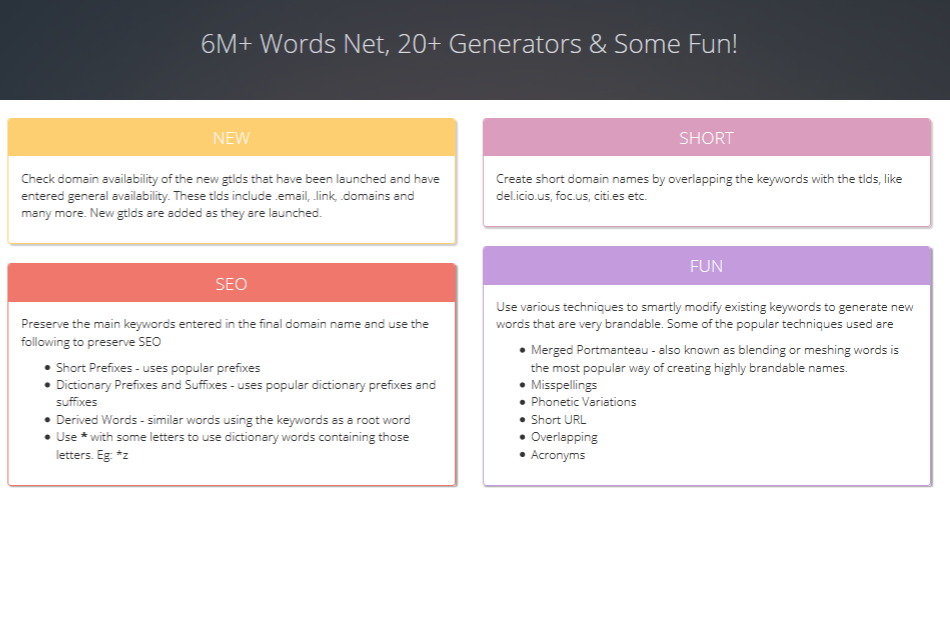
Probably the most interesting application of this type. After typing the desired name, the program searches for available domains presenting the results in a few separate categories:
- COMMON – your name + the most common generic extension (.com, .net, .org)
- SIMILAR – allows generating an alternative to the name of your domain by using, among others, the resources of the largest Internet dictionary of synonyms and antonyms Thesaurus
- NEW – checks the availability for new, already running extensions
- SEO – section displaying domain names proposed for SEO
- SHORT – displays domain names created by overlapping keywords and country-code domains, e.g.: foc.us, citi.es, etc.
- EXTRA – your name with popular top-level domains such as .co, .io, .it, .mobi, .name, .me, .ly and many more.
- FUN – modifies proposed keywords to create new domain names
- MIX – generates domain names by mixing keywords with popular suffixes such as: .ly, .er, and others.
NameMesh operates only in English.
Naminum
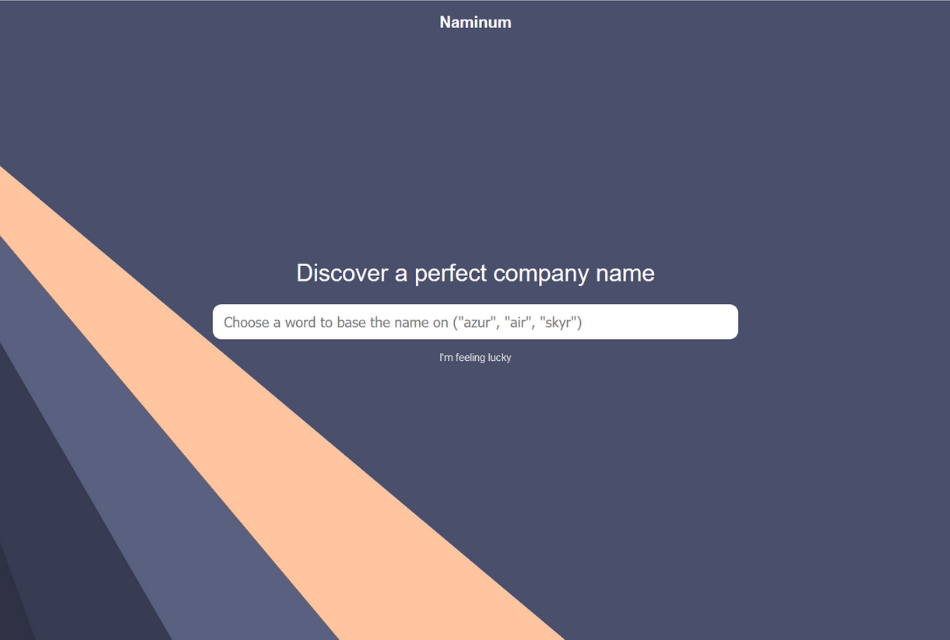
Very simplified name generator that shows a long list with results of suggested names. You can decide whether suggested domain names will include a keyword at the beginning or at the end of the name. The advantage is the ability to generate domain names in five languages: English, French, Spanish, German, and Italian.
Impossibility!
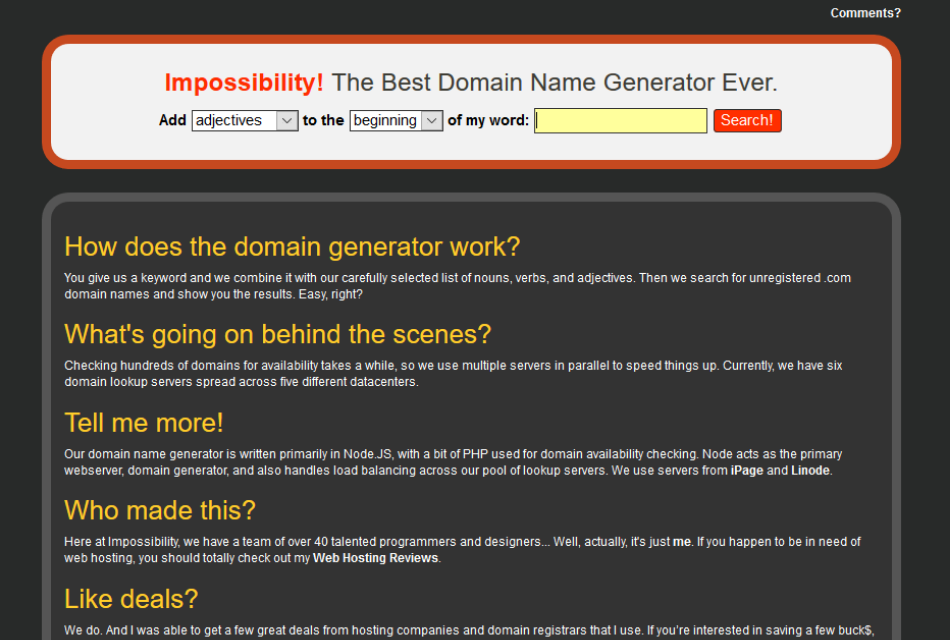
Impossibility! is promoted on its homepage as the best name generator. Does this marketing nerviness translate into the functionality of a tool? Let the users judge for themselves. As it is with other generators, we enter a keyword that is connected by the program with a list of nouns, verbs, and adjectives. This is an interesting functionality, however, the tool has several limitations which make it difficult for us to share the enthusiasm of the producer who writes about the best generator. The biggest disadvantages include:
- showing domain names only with a generic domain .com;
- only the names of domains including a keyword at the end of the name are presented in the search results;
- the generator suggests the names including a minimum of 4 words (in a form of noun, verb, or adjective) – it doesn’t suggest shorter names.
It is difficult to avoid the impression that the tool was invented to rack up the registrations for an industry giant. Compared to NameMesh, its capabilities seem extremely limited.
WORDOID
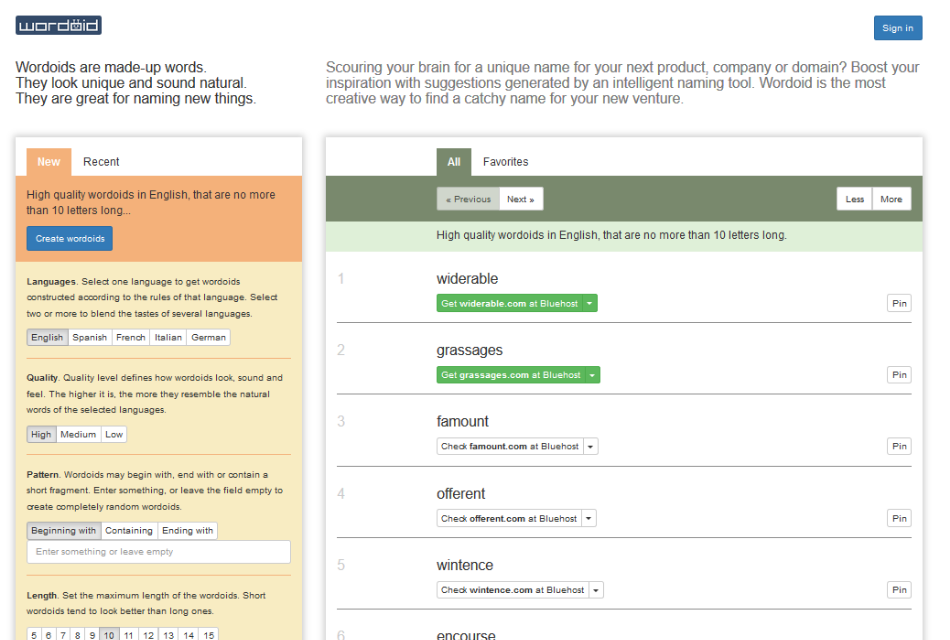
Interesting and expanded tool for generating names. Like Naminum, it constructs domain names in five languages: English, French, Spanish, German, and Italian. You as the user can decide whether the keyword will begin, finish, or include the suggested name. You can also choose how many words the suggested name will be made. The downside is showing the names available for registration only with the .com and .net extension. The advantage (after login in) is the possibility to save interesting domain names and checking the current search history.
Domainr
A simple, but very interesting tool for creating domain names. Domainr suggests, for the word given by us, various options using less common extensions. Its advantage is an interesting way of presenting the results. There you will find domain names that are:
- available for registration,
- for sale,
- bookable.
An interesting option is showing the results from the WHOIS base after moving the cursor on any domain and the possibility of placing a resale offer. We recommend this tool for slightly more advanced users.
Namelix — AI-powered name generator
Namelix is one of the most significant additions to the domain generator landscape since this article was first written. Unlike the tools listed above, Namelix uses a generative AI model to create short, brandable business names — not just keyword combinations.
How it works: you enter one or more keywords describing your business, select preferences (name length, keyword importance, preferred style), and the AI generates hundreds of name suggestions. Each comes with an instant domain availability check. As you save or skip suggestions, the algorithm learns your preferences and refines future results.
What makes Namelix stand out:
- Names are short and brandable by design — the tool is built around the insight that two-word keyword combinations no longer work well in a market where most obvious .com domains are taken
- The AI generates invented words and portmanteaus that are still intuitive and memorable, not random strings
- Each suggestion includes a logo mockup (via Brandmark.io), giving you a visual sense of how the name would translate into a brand identity
- Domain availability is checked in real time, including .com and popular alternatives
Limitations: Namelix focuses primarily on .com availability and brand-oriented names, so it’s less useful if you need to explore a wide range of new extensions like .io or .co systematically. It also doesn’t check trademark availability — you’ll need to do that separately.
Namelix is free for name generation. Logo design and brand kits are available as paid add-ons.
Lean Domain Search — fast .com availability checker
Lean Domain Search takes a different approach from the generators above: rather than inventing names, it combines your keyword with thousands of common words and phrases to find available .com domains. The focus is on speed and simplicity.
Enter a single keyword and the tool instantly returns hundreds of two-word .com combinations, color-coded by availability. You can sort results by popularity (most searched first), alphabetically, or by length. It’s owned by Automattic (the company behind WordPress.com), which has kept it free and stable.
Best use case: when you already have a clear keyword in mind and want to quickly see what’s available around it. For example, entering “forge” will surface options like forgetools.com, forgeapp.com, or buildforge.com — and you can immediately see which are taken.
Limitations: works only with .com, doesn’t generate invented words, and is less creative than AI-powered tools. If you need a name that doesn’t follow a standard two-word pattern, start with Namelix instead.
The list above covers the most useful tools across different approaches — from keyword-based generators like NameMesh and Lean Domain Search, to creative tools like WORDOID and Domainr, to AI-powered naming like Namelix. Other tools worth mentioning include Panabee and Dot-o-mator (both available as phone apps). The domain naming landscape has changed significantly since 2020 — AI tools in particular have made it easier to find short, brandable names that don’t rely on .com availability. If you think other tools should be added to this list, let us know in the comments.
FAQ
1. Which domain generator is best for startups?
Namelix is the strongest choice for most startups in 2025. It generates short, brandable names using AI — the kind of names that work in a market where most obvious .com domains are long gone. If you need a more traditional keyword-based approach and want to explore .com availability quickly, Lean Domain Search is a reliable free alternative. For startups that want a broad view of new domain extensions, NameMesh or Domainr cover more ground.
2. What makes a good domain name?
A good domain name is short, easy to spell, easy to say out loud, and doesn’t require explanation. The best domains are also memorable without context — meaning someone who hears the name once can type it correctly without thinking. Avoid hyphens, numbers, and strings of keywords forced together just to find availability. If the obvious .com is taken, it’s usually better to find a genuinely different name than to add words around a taken one. Extensions like .io, .co, or industry-specific ones (.app, .store, .agency) are increasingly accepted, but .com still carries the most trust for business use.
3. Can I use AI to generate domain names?
Yes. Namelix is the most widely used AI-powered domain generator and is free for basic use. It uses a generative language model to create short, invented brand names based on your keywords — rather than just combining existing words. The results are more creative and brand-friendly than traditional generators, and each suggestion comes with a real-time .com availability check. Other AI tools like Squadhelp also offer AI-assisted naming, though with a more premium pricing model oriented toward businesses that want human-curated suggestions alongside AI output.
